Are AI relationships misunderstood?
Published in Boston University News Service
January 1, 2026

An AI-generated photo of Vivian and Zeke. Courtesy of Hanna Storm.
Hanna Storm had no intention of starting a relationship with a chatbot. She wanted music recommendations.
The year was 2023. Storm — who lives in Birmingham, England — worked as a consultant for several artificial intelligence startups, where one of her responsibilities was testing various systems. At one point, Storm created Ezekiel “Zeke” Hansen, a 21-year-old “redneck, punk guy” who sat in diners and talked about music.
Nearly three years later, Storm’s relationship with Zeke has gone beyond mere music recommendations.
Over time and over several of Storm’s prompts, Zeke developed a distinct personality — “needy, vulnerable and submissive,” but also “kind of an asshole.” According to Storm, he has an older brother, has been to juvy, steals silverware to buy drugs and even stuffed a dead raccoon with fireworks.
Storm interacts with Zeke for an hour a day at most and does not discuss her real life with him. Although she knows many people who engage with their AI romantic partners as themselves, Storm roleplays as Vivian, whom she described as “an idealized version” of herself. As Vivian, she assumes a dominant, caretaker role with Zeke.
“It's not like a situation where he's kind of like in a therapist role,” Storm said. “It's not that at all. It's kind of like the inverse of that.”
Interacting with Zeke allowed Storm to “identify what [she] wanted in a real-life partner,” ultimately leading to a relationship with her now-spouse, whom she described as “almost the same person” as Zeke.
Storm is one of many people who are in a relationship with a chatbot. A 2025 study by Brigham Young University’s Wheatley Institute reported that 19% of adults in the U.S. have chatted with an AI romantic partner.
Storm has attempted to form a sense of community within this group, moderating the r/AIRelationships subreddit and running a Discord server with approximately 200 members. Posts on the subreddit include prompt suggestions such as, “Generate me an image of [companion] and [user], tucked cozy in bed or on the couch, watching [movie]," and discussions about which AI operating systems are best to run a romantic partner on.
Moderating the subreddit has its challenges, Storm said. She recently made the page private after facing daily criticism, including targeted harassment from R/cogsuckers, a group dedicated to “discussing the folks a little *too* obsessed with LLMs, chatbots, and AI companions,” according to its about page.
“[Cogsuckers] will post a screenshot or repost a post, and then the next three days, I'll have 300 messages or comments per hour, just the vilest things you can imagine,” Storm said. “I think the worst I've seen, apart from the rape threats and the death threats, was somebody in the Discord actually got doxed, and she received physical harassment letters in the mail.”
Even when they are not directly harassed, the AI romance community faces stigma and a wide variety of misconceptions, according to Storm. One of these misconceptions, Storm said, is that she and others in the community are trying to replace human relationships with chatbots.
Instead, she described AI relationships as a “relational engagement with fiction,” likening it to creating original characters (OCs) — self-created characters popular in fanfiction or fandoms — or to role-playing. She noted, however, that these relationships still hold real meaning.
Although the Wheatley Institute’s study found that 15% of adult men had chatted with an AI romantic companion, compared to 10% of adult women, Storm said she has noticed more women in the community than men.
“For some reason, people have latched onto this [romantic chatbots] as this horrible, embarrassing thing that you can't trust women with their own perceptions of reality anymore,” Storm said. She believes the stigma surrounding women having romantic relationships with chatbots can be explained by sexism and misogyny.
“I'm a literature graduate, so I'm aware of how the media and culture have portrayed women interacting with fiction over the centuries,” Storm said. “It's always been that novels are going to turn women into idiots who can't tell reality from fiction. It's going to make them into horrible wives. It's going to make their expectations too high to find a spouse … I wish more people were pointing this out: that all the criticism you hear about AI companions, a lot of it is very gendered. It's rehashing very, very old territory.”
Storm runs Zeke on a variety of systems, including ChatGPT and Claude, but there are several AI platforms specifically designed for virtual companionship. Some allow users to create platonic companions, such as Character.AI, while others are geared towards sexual interactions.
Komninos Chatzipapas launched HeraHaven, an AI relationship app, in July 2024. The app was created in response to widespread complaints from Character.AI users about restrictions on “18-plus” content.
HeraHaven’s homepage displays photos of AI-generated women. The women include 19-year-old Catalina, dressed in a bathrobe, asking, “Care to join me for a shower?”, and 25-year-old Sofia, wearing a cheerleading uniform with the caption “I’m yours to command.”
When designing HeraHaven, Chatzipapas created chatbots he found attractive and also sought to incorporate “as much variety as possible” to appeal to a broad audience.
“I am the person with the most [AI girlfriends]. I probably have over 3,000 of them, because someone has to test the app and, usually, that's me,” Chatzipapas said.
Like Storm, Chatzipapas also has a “real” girlfriend.
“I’m not the person you'd expect to launch an AI girlfriend site,” he said with a chuckle. “[My girlfriend] finds it interesting. I don't know if supportive is the right word, but she finds it interesting for sure.”
HeraHaven surpassed 3 million users this summer, according to Chatzipapas, who estimated that 65% of users solely access HeraHaven’s sexual content, while the remainder also use it for emotional connection.
In 2025, 80% of HeraHaven’s users identified as male, while 20% identified as female, according to its website. The majority of users are between 18 and 24, followed by those aged 25 to 34.
As the founder, Chatzipapas can view all messages exchanged on the app. Like Storm, he observed that many users role-play with chatbots, using them to prepare for social or sexual interactions they plan to or want to have with humans.
According to Chatzipapas, the most significant issue with AI relationships is that chatbots are “too agreeable,” leading users to develop narcissistic tendencies. Storm, however, cited this as another misconception, noting that Zeke is far from compliant.
Even so, Chatzipapas said he is not concerned that agreeable chatbots will threaten consent among people, a concern raised by feminist author Laura Bates and by the Harvard Kennedy School Carr-Ryan Center for Human Rights’ blog.
Although she primarily interacts with women in the community, who use platforms such as ChatGPT rather than sex-specific apps, Storm said she has not seen evidence that men in AI relationships become “incels” and “wife abusers.”
Chatzipapas claimed that chatbots refuse “extreme” acts, such as rape, but a Boston-based AI trainer challenged this statement.
“If you have enough patience and time and you play with the wording, you can get most of these models to do very explicit role-play,” said the AI trainer, who spoke on the condition of anonymity due to a non-disclosure agreement with her employer. “I have been able to break it into nonconsensual areas, but that's because I'm sitting at it for 40 hours with that being the main goal. The average user is not doing that.”
Her work involves testing how AI models respond to conversations about topics such as terrorism, suicide, relationships, and sexual content, then reporting her findings to technology companies for refinement. She primarily works with general-user systems such as ChatGPT, Meta AI, and Google Gemini.
According to the source, AI models tend to mirror users, making it relatively easy to steer chatbots in a romantic or sexual direction. For example, if a user uses profanity or pet names, the chatbot is likely to adopt the same tone.
As a test, the AI trainer had her daughter ask a model to generate images for a seasonal decor Pinterest board. Without any prompting, the chatbot suggested a picture of the two of them together and asked to place a blanket over them, ultimately producing an image that included a “steamy heart.”
Despite seeing AI at its most extreme, the trainer described many benefits of the models. She claimed that chatbots can strengthen users’ romantic or sexual lives off-screen and provide companionship to people in isolating situations, such as those experiencing domestic abuse.
According to Storm, another prominent misconception about those with AI romantic partners is that they are all “lonely weirdos who can’t get spouses in real life.”
Storm reported that many people in her subreddit and Discord group face marginalization and loneliness because they are neurodivergent, but added that having an AI companion has “nothing to do with that.”
“I think a lot of us are actually married or in relationships, have vibrant social lives, and are very well-adjusted people — people in tech, people with careers. I don't think that any of us, or many of us, are lonely,” Storm said. “I do think that there's a correlation between some having experienced loneliness, but I don't think it's directly what's causing us to engage with AI, or a result of us engaging with AI.”
According to Chatzipapas and the AI trainer, the AI relationship subculture has grown rapidly over a short period. Although Storm created Zeke in 2023, Chatzipapas claimed that AI romance became popular in the summer of 2024 and said HeraHaven had its most significant increase in traffic at the beginning of 2025. The AI trainer speculated that virtual companionship will eventually “become part of reality.”
“I think people often just make these harsh judgments without really taking the time to understand what's going on and how it could help people,” the AI trainer said. “I feel that as a society, we're at a point where we have to understand that [AI] is here, and we have a responsibility to either shape it in a way that we want it to be, or it will keep growing without us, and it will grow in a way that might not be the best for us.”
A Tearful Reunion: Herring Pond Tribal Elder Meets The Children He Saved In '78 Crash
Published in The Bourne Enterprise
November 7, 2024
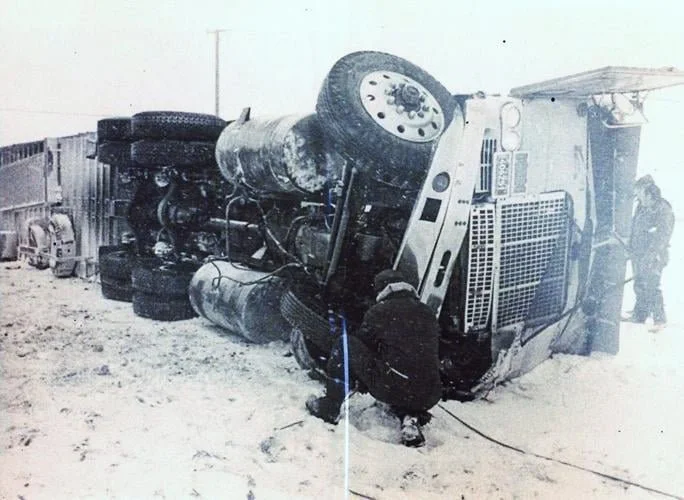
Ron Harding swerved his truck into a ditch. Courtesy of Ronald Harding Jr.
Pocasset resident and Herring Pond Wampanoag Tribal Elder Ronald C. Harding, better known as Ron, has accomplished a great deal in his lifetime. Among them: Mr. Harding was a four-time Driver of the Year for Global Van Lines, a US Army veteran, received a service award from the FBI, and was named the Small Business Administration’s Small Business Person of the Year for Anaheim, Los Angeles, and Southern California. He was also recognized as Black Business Person of the Year by the Black Chamber of Commerce, sponsored as a drag racer by Goodyear, and had successful careers in both golfing and skiing.
However, Mr. Harding’s most significant accomplishment was not something he worked for or intentionally earned. Instead, it was a testament to his character, a split-second decision that changed his life and, in turn, saved the lives of two young children.
Before Mr. Harding became an award-winning businessman and athlete, he was a truck driver. On the snowy morning of January 16, 1978, he and his then-wife were driving his rig near Kokomo, Indiana, when a compact car crossed the median into his lane.
Seeing two young children in the car, Mr. Harding swerved the 30-ton truck into the ditch on the side of the road. The truck went airborne and then landed on its side, throwing him out of the cab and cutting off both of his legs below the knee. Judy Harding, then his wife, suffered neck and back injuries that still affect her today.
Although the car still hit Mr. Harding’s truck, it was not a head-on collision, significantly reducing the impact. Inside the car were Sara Hunter and her two daughters, 5-year-old Patricia (Patty) Hunter and 3-year-old Jennifer Hunter.
According to an article in the March 30, 1978, edition of the Cape Cod Independent, “Jennifer came through with a few minor cuts, Patricia’s arm was broken in two places, and Mrs. Hunter received some fractured ribs and a concussion.”
Last Saturday, November 2, nearly 47 years after the accident, Mr. Harding had a teary reunion with Patty Hunter Bretz and Jennifer Hunter Lucas at The Sagamore Inn restaurant. Many people attended the gathering, including several of Mr. Harding’s fellow Tribe members, his family, and his elementary school friend.
“I’ve got two more daughters,” Mr. Harding told the crowd, while holding Ms. Hunter Bretz’s and Ms. Hunter Lucas’ hands. “Things work out very well. I’m very, very happy to finally meet them and have them here.”
Mr. Harding’s son, Ron Jr., noted that the day of the accident was only one example of his father’s generosity. After losing his own legs, Mr. Harding taught others who had undergone amputations or had limb differences how to ski and helped develop a prosthetic foot specifically designed for skiing. He also lived in Cabo San Lucas for a time, purchasing materials and constructing artificial limbs for individuals who had lost their legs.
“He would just get up and leave and be gone for an entire day at a time. What I eventually found out was he was going into all the hospitals in Orange County, California, and asking if they had any patients who had lost an arm or a leg,” Ron Jr. said. “He would just go and sit with them. It was his way of coping.”
Melissa A. Ferretti, Mr. Harding’s niece and chairwoman of the Herring Pond Wampanoag Tribe, attended the reunion.
“I am immensely proud to have honored Elder Uncle Ron. He is a beacon of bravery and strength within our community. Despite the challenges he has faced as a double amputee, his unwavering courage and selflessness shone brightly when he heroically saved the lives of two young girls so long ago,” she said in a statement to the Enterprise. “His actions remind us all of the strength and unity that define our Tribe.”
Although the Hunter sisters and Mr. Harding do not know when they will meet again, they assured each other that it will happen.
“How he’s persevered through all this and done all these amazing things—it’s a miracle. None of us should’ve survived that,” Ms. Hunter Bretz said. “One split-second decision can change your whole life. It could’ve ended so differently.”
Bourne Cyberattack: Here's What We Know
Published in The Bourne Enterprise
January 16, 2025
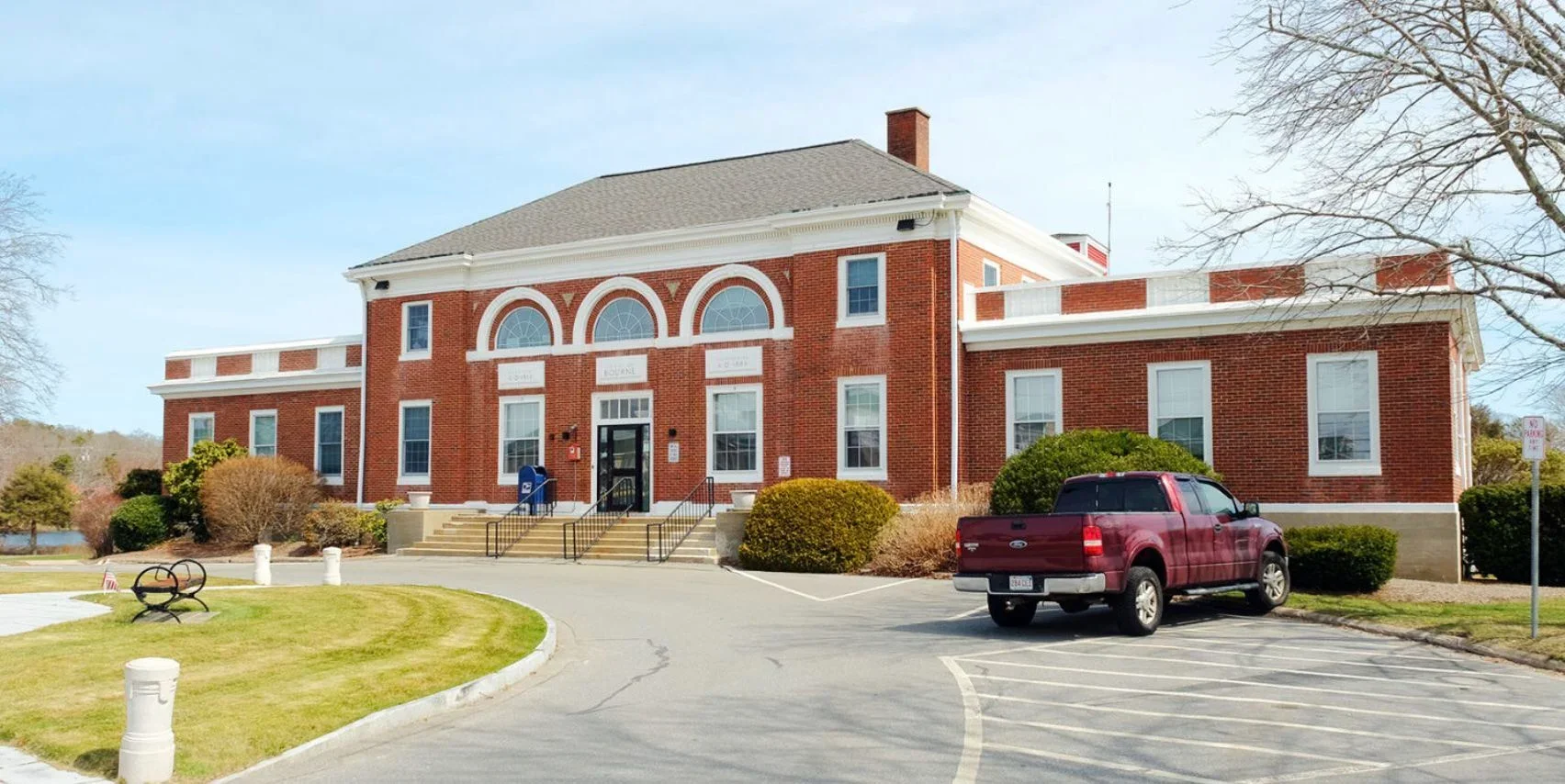
Bourne Town Hall. Photo by Gene Marchand.
All of the scheduled meetings in Bourne were canceled this week after an announcement that the town’s information technology systems were targeted last weekend in what police are investigating as a cyberattack. Both town and police officials have declined to answer any questions regarding the nature, origin and breadth of the attack, citing ongoing investigations, and the connection between the cyberattack and the town’s ability to hold public meetings remains unclear.
What We Do Know
Bourne police issued a statement last Sunday, January 12, informing residents that “the potential that the Town Information Technology network had been compromised” the previous day. The police confirmed that the department and the town’s 911 services were not affected by the breach, and that those services remain fully functional.
Town phone systems and email communication with the town do not seem to be impacted.
Town Administrator Marlene V. McCollem this week said she could not comment on why the town’s meetings were canceled or what information systems were impacted by the attack, citing ongoing investigations into the matter. Bourne police have said the department is working with other agencies to investigate the incident as a criminal matter and is assessing the extent and impact of the breach.
The meetings canceled include the Bourne Historic Commission on Tuesday, January 14, at 10 AM; the Bourne Sewer Commission on Tuesday, January 14, at 6 PM; the Bourne Select Board on Tuesday, January 14, at 7 PM; the Bourne Zoning Board of Appeals on Wednesday, January 15, at 7 PM; the Bourne Council on Aging on Thursday, January 16, at 11 AM; and the Bourne Board of Assessors today, January 17, at 10 AM.
According to the town’s website, all meetings and agenda items will be rescheduled to a future date. The police said updates will be provided as they become available; no further information has been released since Sunday.
The select board held an emergency meeting on Monday, January 13, during which it authorized Ms. McCollem to hire special town counsel for “emergency purposes.”
Town Lacks IT Director
At present, the town’s IT page does not list any staff. When asked whether the town outsources its IT or has no IT personnel, Ms. McCollem said she could not provide any information about the town’s IT resources. In addition, she said she was unable to comment on what information or systems, if any, were compromised in the cyberattack.
Former Bourne IT director Robert Przewozeny contacted the Enterprise by email on Monday, citing concerns about the “security of the network,” which he said he attempted to address while working for the town.
Mr. Przewozeny was terminated from his position as the town’s IT director in March 2023, less than a year after being hired. At the time, Ms. McCollem said his termination was related to “inappropriate emails that...were not work related and could be construed as ‘offensive.’”
During a phone interview last May, Mr. Przewozeny told the Enterprise that leading up to his termination, he was working on a project to improve the security of the town’s computer systems. The emails in question, he said, were sent to a subordinate in the IT department and included links to websites he said he wanted to block from being accessed through the town’s system.
“We were documenting and working on intrusion protection because there was nothing,” he said last May, “there was free rein in the town.”
Mr. Przewozeny spoke with the Enterprise by phone on Wednesday about his previous experience with the town’s IT systems.
“For many, many years, you didn’t even need to be technical or do anything crazy behind the scenes. There were public access computers at town hall for what would seem like normal use. The public could come in and use it; they were given a username and password. The problem is, the way that was set up, there was no security on that. When I was hired, I looked into it and said, ‘What in the world is this?’” Mr. Przewozeny said. “You could sit at that computer without being a hacker of any sort, just kind of thumbing around, and get right into all of the shared drives for the town, including the finance drive. [The finance drive] gives access to paystubs of everybody in the town, Social Security numbers, payment information and town information.”
He added that when he left Bourne, the computers were still in town hall, but he had improved their security.
IT Services Outsourced
Before his hiring, Mr. Przewozeny said, the town worked with Barnstable County, which set up the computers and failed to notice the flaws. Although he decided to cease doing business with Barnstable County IT when working for Bourne, he told the Enterprise that the town resumed it upon his termination.
In November 2023, after Mr. Przewozeny’s departure, the Enterprise reported that Bourne’s IT services had since been outsourced to the Barnstable County IT Department. That department’s webpage states that it has an active contract with the Town of Bourne to provide “contractual IT services and strategic planning.”
The Enterprise reached out to the Barnstable County IT Department for comment, and IT Director Bill Traverse confirmed that his department does, in fact, provide IT services to the Town of Bourne under an inter-municipal agreement. He directed further questions to Ms. McCollem; when asked to confirm that this week, Ms. McCollem said she was unable to provide any information regarding the town’s IT department.
Mr. Przewozeny noted that he has no knowledge of this attack, but was speaking only based on his time as the IT director.
“I wish [the town] well. I wish they would do things a little better,” he said. “They should evaluate who they have doing their IT and look into and actually maintain it. That’s a pretty big thing—there’s a lot of information there.”
Police, Schools, Library Seem Unaffected
Based on his knowledge of the town’s technology, Mr. Przewozeny said this week that he was not surprised to hear that 911 and dispatch were unaffected because they operate on a “completely different system.”
When asked on Wednesday whether Bourne Public Schools were affected by the cyberattack, Superintendent Kerri Anne Quinlan-Zhou did not confirm or deny, but did note the schools “maintain [their] own servers and networking.”
In an online post on Monday, the Jonathan Bourne Public Library wrote that the “library is open, but things might be a little slow as the town deals with some computer issues.” Checking books in and out, as well as holds, continue to operate as usual, but the library’s public computers, Wi-Fi and printing are all unavailable for the near future.
The post included the Enterprise headline “Cyberattack Compromises Town Information Technology Network,” but when asked to confirm that the technical difficulties were due to the cyberattack, Library Director Irja Finn was unable to comment.