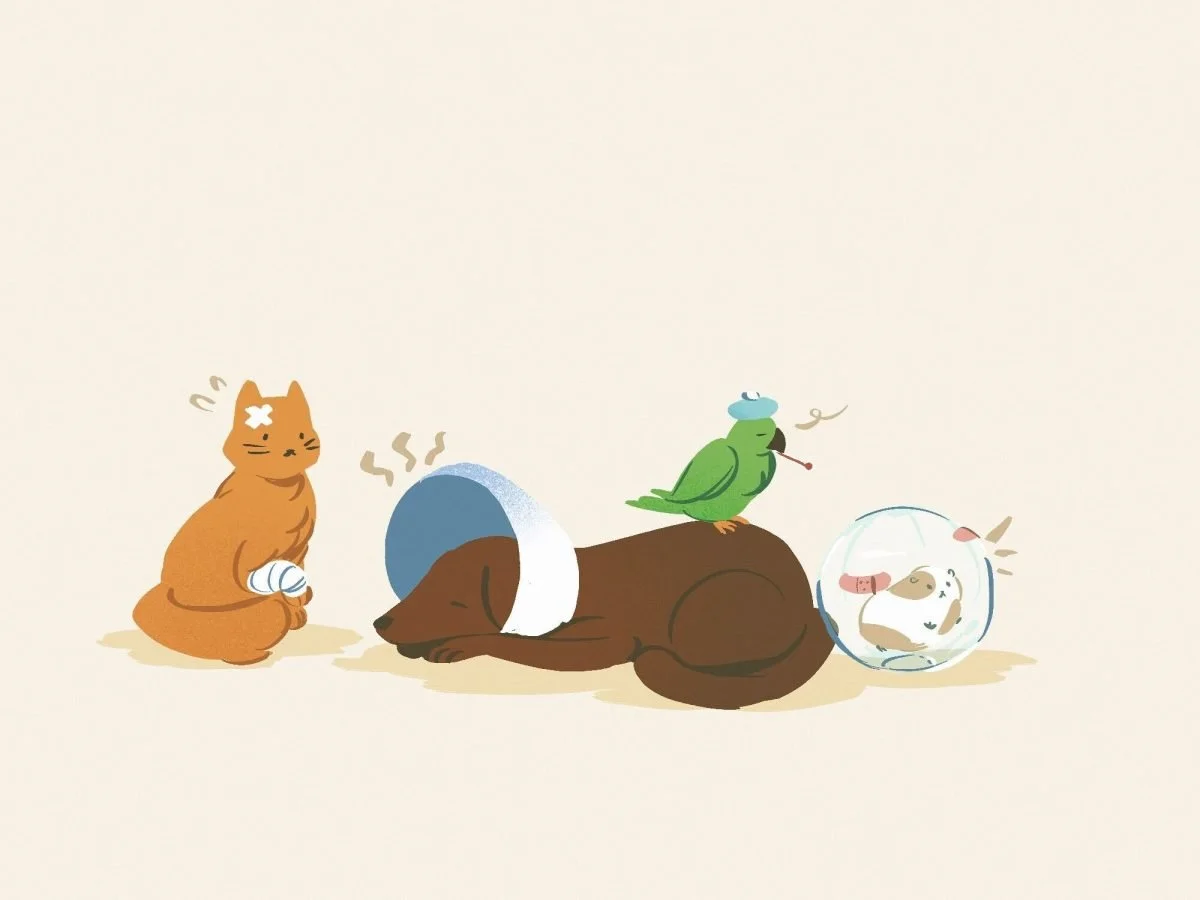
Illustration by Emma Hart
I was sitting on a hard, wooden bench with my dog — and best friend — Kinzie at my feet. My heart was pounding in my chest, the unknowns tangling themselves around each other in my head. The veterinary emergency room was the last place I wanted to be and certainly the last place Kinzie wanted to be.
At the sound of the sliding glass doors, I looked up to see a man in his 50s walk in, sporting a full suit. In his hands lay a small plastic box with a purple lid. He strode up to the front desk with all the confidence of an accomplished businessman and checked in his pet, Turtle Bob the turtle.
I suddenly had a strong affinity for the man and felt a pang of tenderness in my gut. Perhaps Turtle Bob belonged to his child, but in my mind, this serious man was the sole owner.
The idea of a grown man naming his pet Turtle Bob and caring enough about him to foot the always-expensive emergency vet bill made me not-so-slightly emotional, as evidenced by the fact that I still think about the pair months later.
Unfortunately, that was not the only time I’ve had to bring Kinzie to the emergency room. She’s 12 years old and miraculously active and healthy, but occasionally, she has a random bout of illness.
Just last week, we landed at the Massachusetts Society for the Prevention of Cruelty to Animals emergency room after she ate part of a cinnamon raisin bagel off the street before I could stop her. By the way, raisins are highly toxic to dogs — please pick up your trash. One stranger cries, and another passes a tissue. When the vending machine ate my dollar, a woman at a nearby table offered me her extra Coke Zero. It’s like a wordless group therapy session.
As the hours pass and social media loses its appeal, people begin talking to each other. I imagine it resembles what life used to look like — before technology took over and individualism became the norm.
Although your own pet is always your priority in these situations, it’s easy to become attached to other animals. Typically, only the pet parents receiving the most dire news are taken to a private space. Otherwise, doctors and nurses provide updates in the waiting room. Although they try to speak in hushed tones, it’s a small space, and overhearing is inevitable.
Then, there are the people who actively seek out conversation. They ask about your pet or gush about their own.
Most recently, there was Cutie’s mom. She complained about her boyfriend, who was waiting in the car at the time, complaining about spending money on medical treatment for an old dog. Before that, I met Mr. Ferguson’s owner, a sweet older lady who clung to her friend’s hand as she told me she was opting out of life-extending but pain-inducing treatment for her pet.
It does not feel at all forced to comfort strangers in the emergency vet waiting room — nor does it feel awkward to accept it.
Kinzie was once a family dog, but I’ve been her primary caregiver since I brought her with me to undergrad four and a half years ago. Being solely responsible for her has never bothered me. I’m happy to forgo nights out to curl up in bed with her and to wake up early for long walks before class.
However, it can be lonely and frightening during emergencies. On more than one occasion, older pet owners have approached me in the waiting room, saying they notice I’m young and alone and that they hope Kinzie and I are okay.
Each time Kinzie is discharged with a clean bill of health, I leave not only with a sense of relief but also with a renewed faith in humanity.
Why must it take hours of boredom and anxiety to finally turn to the person next to us and strike up a conversation?
It is human nature to seek connection, and it’s just as meaningful when it comes from a stranger. I hope Kinzie and I never find ourselves at the emergency vet again. I do, however, hope to discover and replicate that sense of community elsewhere.
